
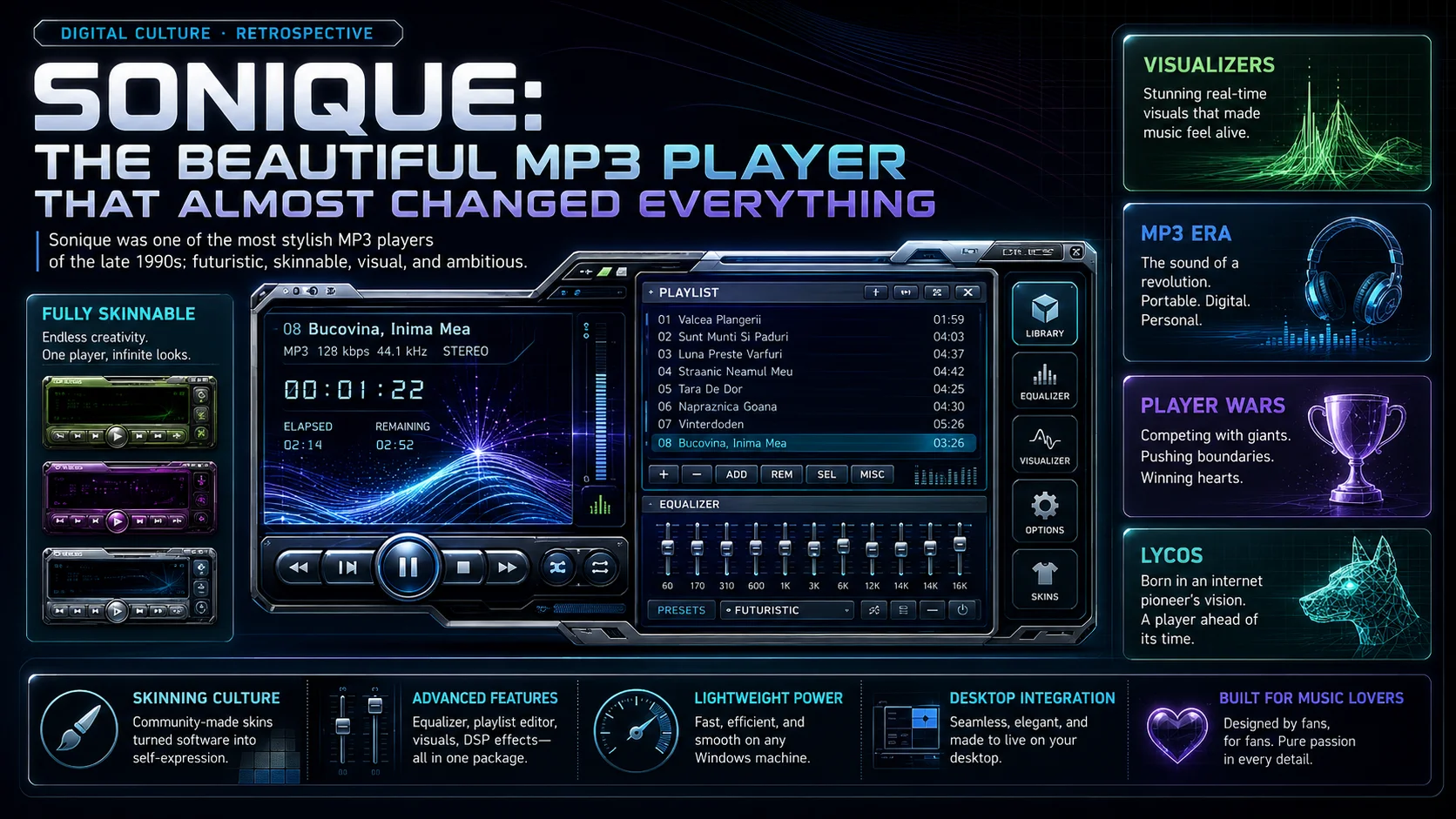
Sonique was one of the most stylish MP3 players of the late 1990s: futuristic, skinnable, visual, and ambitious. It never defeated Winamp, but it proved that a media player could be more than a tool.
The MP3 Player That Wanted to Look Different
In the late 1990s, the MP3 player became one of the most important applications on a Windows desktop.
Before streaming services, cloud libraries, smartphones, and algorithmic playlists, music lived in files. Users ripped CDs, downloaded tracks, renamed folders, edited ID3 tags, built playlists, and arranged their collections by artist, genre, mood, or pure chaos.
For most people, the king of that world was Winamp. But Winamp was not alone.
For a few years, one player looked like it might become the stylish alternative: Sonique.
Sonique was futuristic, strange, elegant, experimental, and deeply connected to the same visual culture that made desktop skinning so exciting. It did not simply try to copy Winamp. It tried to outstyle it.
Where Winamp felt like a compact stereo component, Sonique felt like something from a science-fiction interface lab. It was smooth, curved, animated, and visually ambitious. It cared about the experience of looking at music as much as listening to it.
For Skinbase, Sonique is important because it represents one of the purest examples of early skinnable software culture. It was a media player built around the idea that users and artists should be able to reshape the interface. It treated skins not as decoration, but as a core part of the product’s identity.
Sonique never became the long-term winner of the MP3 player wars. But for a moment, it showed what digital music software could have become.
A Different Kind of Winamp Rival
Winamp became famous because it was fast, lightweight, familiar, and easy to extend. Its interface was compact and practical. Its skins made it personal, but the basic structure stayed recognizable.
Sonique took a different path.
It wanted to make the entire player feel more fluid. Its interface was not restricted to the traditional rectangular Windows application shape. It embraced irregular forms, unusual layouts, animated menus, visual effects, and interface designs that felt closer to digital art than standard software.
This made Sonique attractive to users who wanted something more visual than Winamp.
It also made Sonique attractive to skinners.
A Sonique skin could be more adventurous. Instead of simply repainting a fixed player shape, designers could imagine more unusual forms. Buttons could live in unexpected places. The player could look like a futuristic device, an organic panel, a liquid surface, a sci-fi console, or an abstract object.
That freedom was Sonique’s strongest identity. It was not only a media player. It was a challenge to the idea that software had to look like software.
The Origins: From Vibe to Sonique
Sonique came from the early MP3 explosion, when small teams and independent developers were racing to define how digital music should work on the desktop.
The player was connected to Andrew McCann, Ian Lyman, and the earlier Vibe MP3 player project associated with Montana State University. After Vibe, the team moved toward a more ambitious music player concept that became Sonique.
This was a perfect moment for a new audio player.
The MP3 format was spreading quickly. Users wanted smaller music files, portable collections, and better playback tools. The music industry was still trying to understand what the internet would do to music, while users were already living in the new reality: songs were becoming files.
The late 1990s were full of competing audio players, download sites, file-sharing conversations, and arguments about formats, quality, piracy, licensing, and the future of music. In that environment, a player needed to stand out.
Sonique stood out visually. Even if a user had never played a song through it, one screenshot could make it memorable.
The Interface: Smooth, Futuristic, and Unusual
Sonique’s interface was its greatest strength.
The player looked different from typical Windows software. It avoided the standard gray window, standard menu bar, and standard button layout. It used a more stylized design language, with smooth surfaces, curved forms, glowing displays, animated elements, and an interface that felt closer to a physical music device than a spreadsheet-era application.
This mattered because MP3 players were emotional software.
Users did not open a music player only to complete a task. They kept it visible while doing everything else: browsing the web, chatting with friends, designing graphics, playing games, studying, coding, or organizing folders. The music player sat on the desktop like a companion.
Sonique understood that.
Its design suggested that listening to music on a computer could be visually immersive. It was not enough for a player to produce sound. It could also create mood.
That is why Sonique became memorable even to people who never used it as their main player. It looked like the future of music software.
Skins Without the Rectangle
The most important difference between Sonique and many earlier media players was its approach to skinning.
Traditional skinned applications often gave artists a fixed template. Designers could change the colors, textures, and graphics, but they had to work within a strict shape and layout. That made skins easier to build and easier to use, but it also limited the imagination.
Sonique pushed further.
It supported more flexible, irregular skin designs. Skinners could create interfaces that felt freer and more sculptural. A skin did not have to look like a normal rectangle. It could become a custom object.
This made Sonique exciting for the skinning community.
For artists, it offered a bigger creative challenge. For users, it created the feeling that every skin might be a completely different experience.
This also created one of Sonique’s weaknesses. A very creative interface is not always easy to understand. Sometimes users had to search for controls. A beautiful skin could be confusing. A futuristic design could hide basic functions. What looked impressive in a screenshot might not always be practical in daily use.
That tension between beauty and usability is one of the most interesting parts of Sonique’s story. It was trying to move software interface design forward, but it also showed why design freedom needs discipline.
Visualizers and the Experience of Seeing Music
Sonique was also known for its visual side.
The late 1990s and early 2000s were a golden period for music visualizers. Users loved watching waveforms, particles, tunnels, pulses, abstract shapes, and color fields react to audio. A good visualizer could make a music player feel alive.
Sonique embraced that culture.
Its visualizers helped reinforce the idea that digital music was not only something you heard. It was something you watched. On a CRT monitor in a dark room, with speakers or headphones playing MP3s, a visualizer could feel almost hypnotic.
This was before music apps became clean, flat, and mostly album-art-driven. Back then, media players were allowed to be weird. They could look like control panels, light machines, digital sculptures, or nightclub screens.
Sonique fit that world perfectly. It made music feel like an interface performance.
A Player Built for the Skinning Era
Sonique arrived at the right cultural moment.
The late 1990s were not only about MP3s. They were also about customization. Users were discovering that software did not have to remain visually fixed. Winamp skins were everywhere. Windows themes were growing. ICQ skins, browser skins, desktop widgets, shell replacements, and custom cursors were becoming part of online identity.
Sonique belonged to that same movement.
It was especially appealing because it looked designed for skinners from the beginning. It did not feel like an ordinary application that later received skin support. It felt like a visual platform.
This made Sonique important for communities like Skinbase. The player represented the belief that software could be personal, visual, collectible, and expressive.
A Sonique skin could be treated like digital artwork.
Users could collect skins not only because they needed a different interface, but because they enjoyed the creativity. The skin became part of the music experience. It changed the mood of the player, the desktop, and sometimes the entire workstation.
The Lycos Acquisition
Sonique became visible enough that larger internet companies noticed.
In 1999, Lycos acquired Internet Music Distribution Inc., the company behind Sonique. At the time, major portals were trying to build positions in digital music. MP3 was no longer a niche format. It was becoming one of the biggest topics on the web.
For Lycos, Sonique was more than just a player. It was a way to connect search, playback, radio, downloads, and online media strategy. A popular MP3 player could become a gateway into a broader music ecosystem.
This was the same period when internet companies were racing to own pieces of the online music future. The rules were not settled yet. Nobody knew exactly whether the future would belong to downloads, streaming, portals, labels, devices, software players, or file-sharing platforms.
Sonique looked like a valuable piece of that puzzle.
The acquisition gave Sonique attention and corporate backing. But it also placed the player inside the turbulence of the dot-com era.
Sonique 2: The Big Reinvention That Never Fully Arrived
After the acquisition, the next big promise was Sonique 2.
Sonique 2 was expected to move beyond the first-generation player and become a more complete platform for digital music. It was supposed to improve the interface, expand the experience, and help Sonique compete in a market that was becoming more crowded and more complicated.
But Sonique 2 never became the broad, stable, mainstream release that fans hoped for.
This became one of the great what-if stories of MP3 player history.
What if Sonique 2 had arrived earlier? What if it had been polished enough to challenge Winamp more seriously? What if Lycos had continued to invest strongly in the team? What if Sonique had evolved into the visual music platform it seemed capable of becoming?
Instead, the dot-com crash changed the environment. Many internet companies reduced teams, abandoned projects, or shifted priorities. Sonique’s original momentum faded. The team behind it was disrupted, and the player lost the development energy it needed.
In software history, timing matters as much as design. Sonique had style, ambition, and recognition. But it did not have enough sustained momentum.
Why Sonique Did Not Beat Winamp
Sonique was beautiful, but Winamp was stronger in everyday use.
Winamp had several advantages. It was already deeply established. It was fast. It had a huge library of skins and plug-ins. It was familiar. It had strong community support. It handled playlists well. It became part of the default setup for millions of users.
Sonique had visual magic, but Winamp had habit.
That difference mattered.
Most users choose a media player not only because it looks good, but because it fits into daily behavior. It needs to open quickly, play everything, manage playlists, work with plug-ins, stay stable, and feel predictable.
Sonique’s visual experimentation made it exciting, but also made it less straightforward. Some users loved the interface freedom. Others found it too strange. The same design philosophy that made Sonique special also made it harder to become the universal default.
Winamp was customizable but still recognizable. Sonique was more radical. In a niche creative community, radical design can be a strength. In a mainstream software battle, it can become a limitation.
The Player Wars and the Changing Music World
Sonique also faced a rapidly changing market.
The MP3 player wars were not only about Winamp and Sonique. Users also had Windows Media Player, RealPlayer, MusicMatch Jukebox, JetAudio, Foobar2000, MediaMonkey, iTunes, and many smaller tools. Some focused on local files. Some focused on libraries. Some focused on streaming. Some focused on formats. Some focused on devices.
Then the center of digital music began to move.
Apple’s iTunes and iPod changed user expectations. Music software became tied to libraries, stores, syncing, album art, portable devices, and eventually phones. Later, streaming services changed everything again.
Sonique was born in the local MP3 era: the era of folders, files, skins, playlists, and visualizers.
That world did not disappear overnight, but it stopped being the future of mainstream music. As digital music moved toward ecosystems and services, a visually experimental desktop player became harder to sustain as a major product.
Sonique had been designed for one of the most creative moments in desktop software. But that moment was already shifting.
Why People Still Remember Sonique
Sonique is remembered because it had identity.
Many old media players existed. Not all of them are remembered with affection. Sonique is remembered because it looked and felt different.
It represented a more imaginative version of software design. It showed that an application could be playful, futuristic, artistic, and visually expressive. It took the idea of skins seriously and pushed it beyond simple repainting.
People remember Sonique because it felt like a glimpse of an alternate future.
In that future, media players might have become more like visual instruments. Interfaces might have become more flexible. Skinners might have had even more control. Music software might have remained a place for experimental UI design instead of moving toward standardized libraries and streaming apps.
That future did not fully happen. But Sonique proved it was possible.
Sonique and Skinbase
Sonique belongs naturally in Skinbase history.
Skinbase has always been connected to the idea that digital interfaces can be collected, customized, and appreciated as creative work. Sonique was exactly that kind of software.
It encouraged users to see the media player as a visual object. It gave skinners a more open canvas. It made screenshots exciting. It connected music, interface design, and desktop personality.
The same users who cared about Winamp skins, WindowBlinds themes, ICQ skins, cursors, widgets, and wallpaper sets could easily understand Sonique’s appeal.
It was not only about playback. It was about presence.
Sonique looked good sitting on the desktop. It made the computer feel more alive. It belonged to the same world as glowing system monitors, custom shells, brushed metal themes, sci-fi wallpapers, and late-night MP3 playlists.
For a community like Skinbase, that makes Sonique more than a forgotten player. It makes it part of the visual culture of the desktop.
The Beauty of Almost
Sonique’s story is powerful because it is not a simple success story.
It did not dominate the market. It did not become the default player for a generation. It did not survive into the modern era the way Winamp did. It did not complete the grand promise of Sonique 2.
But it almost changed everything.
It almost became the player that pushed interface design further. It almost turned music playback into a more visual, flexible, skin-driven experience. It almost became the stylish alternative that could stand beside Winamp for the long term.
That almost is part of the appeal.
Some software is remembered because it won. Some software is remembered because it was beautiful, ambitious, and slightly ahead of its time.
Sonique belongs to the second group.
Timeline: Sonique and the MP3 Skinning Era
1997: The roots of Sonique begin with earlier MP3 player experiments connected to the Vibe project and the growing digital audio scene.
1998: Sonique emerges during the early MP3 boom and gains attention for its futuristic interface and more flexible approach to skinning.
1999: Sonique becomes one of the more visible Winamp alternatives. Lycos acquires the company behind Sonique as major internet portals compete for a place in digital music.
2000: Sonique reaches a major visibility point within the skinning scene. Its downloads grow, its skins become part of customization culture, and it is widely discussed as one of the most stylish audio players of the era.
2001: The dot-com crash and changing corporate priorities begin to affect many internet music projects. Sonique’s long-term future becomes less certain.
2002: Development slows and Sonique’s first-generation line reaches its later releases. Sonique 2 remains an unfinished promise rather than a full mainstream comeback.
2000s and beyond: Winamp, iTunes, Windows Media Player, portable devices, and eventually streaming services reshape the digital music landscape. Sonique becomes a remembered classic rather than an active competitor.
The Legacy of Sonique
Sonique’s legacy is not measured only in market share.
Its real legacy is visual.
It pushed the idea that media players could be expressive. It challenged the fixed rectangle. It gave skinners a more adventurous canvas. It showed that music software could look like art, not just a utility.
In the history of desktop customization, Sonique is one of the great stylish almost-winners.
Winamp became the icon. iTunes became the ecosystem. Streaming became the mainstream future.
But Sonique remains something special: the beautiful MP3 player that tried to make digital music look as exciting as it sounded.
For Skinbase, that is exactly the kind of software worth remembering.
Connected in Nova
4 linkeden.wikipedia.org
Reference link
https://en.wikipedia.org/wiki/Sonique_%28media_player%29
wired.com
Reference link
https://www.wired.com/2000/10/skins/
internetnews.com
Reference link
https://www.internetnews.com/it-management/lycos-grabs-sonique-mp3-player/
techmonitor.ai
Reference link
https://www.techmonitor.ai/technology/lycos_buys_net_music_distribution_for_sonique_mp3_player
Related Articles
MP3: The File Format That Changed How We Listen
MP3 changed music forever by turning songs into small files, powering CD ripping, file sharing, Winamp, portable players, personal libr...
The Golden Age of Desktop Skinning
Before flat design and locked-down interfaces, desktop skinning turned media players, messengers, cursors, widgets, taskbars, and entir...
The Rise, Fall, and Return of Winamp
From its 1997 launch to its skinning culture, AOL years, shutdown scare, and modern creator-platform revival, Winamp remains one of des...
Conversation
0 Comments
Keep the discussion focused on the article. Safe markdown formatting is supported for signed-in members.
No comments yet
Start the conversation if you have feedback, context, or a question about this update.