
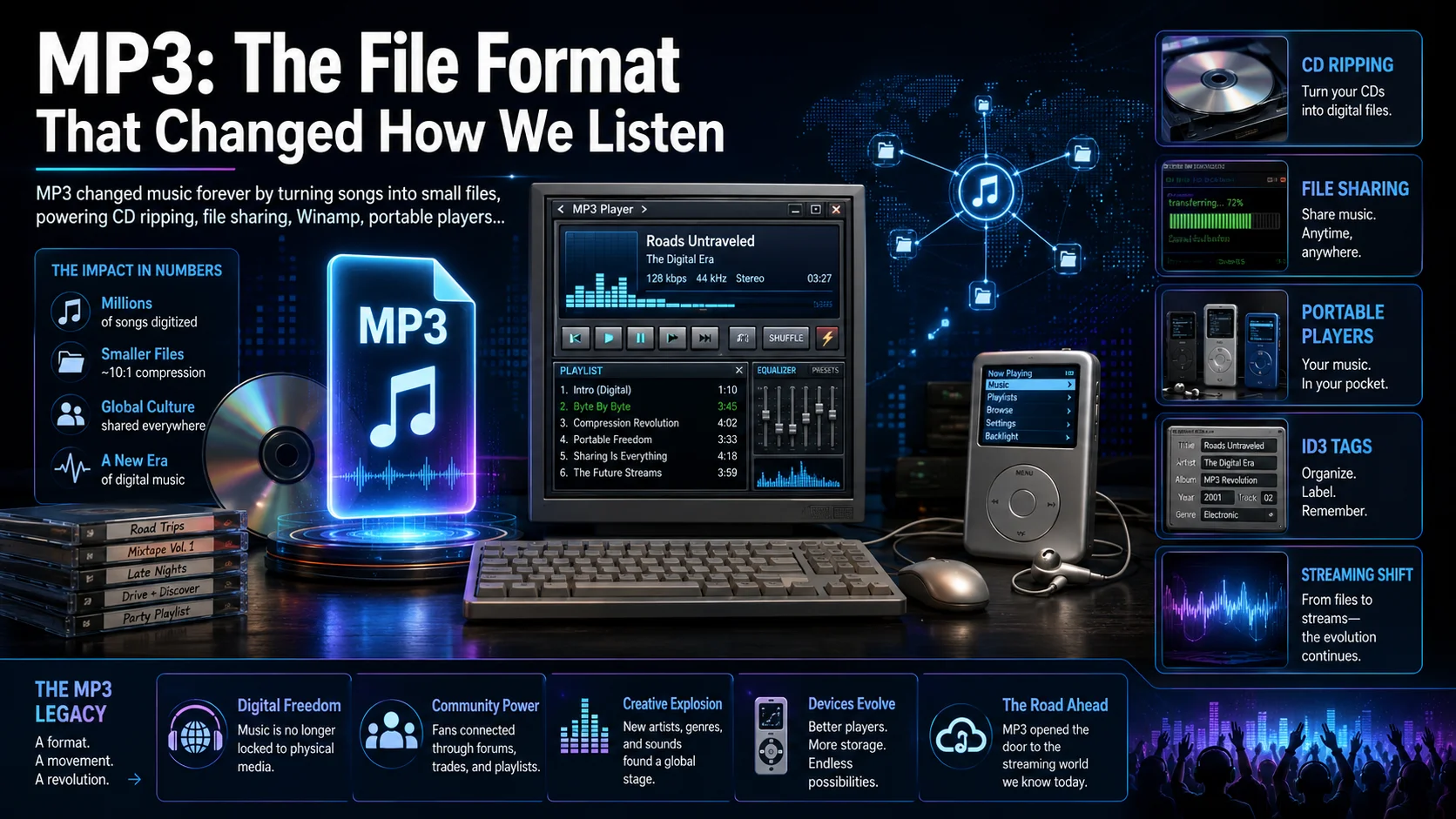
MP3 changed music forever by turning songs into small files, powering CD ripping, file sharing, Winamp, portable players, personal libraries, and the path toward streaming.
The File Format That Escaped the Laboratory
Some technologies change the world because they are loud, expensive, and announced from a stage.
MP3 changed the world quietly.
It was just a file format. Three letters at the end of a filename. A small compressed audio file that could be copied, renamed, stored, shared, downloaded, played, burned, uploaded, tagged, and carried in a pocket.
But those three letters changed music forever.
Before MP3, music was mostly tied to physical media: vinyl, cassette, CD, MiniDisc, and radio. You could own albums, make mixtapes, record from the radio, or carry a portable CD player, but music still had weight. It lived on objects.
MP3 separated the song from the object.
A track no longer had to be attached to a CD. It could live as a file on a hard drive. It could move through a modem. It could sit inside a folder named Music. It could be copied to a portable player. It could be organized by artist, album, genre, mood, or whatever naming system the user invented at 2 AM.
For the Skinbase audience, MP3 matters because it was deeply connected to desktop culture. MP3 was the reason people installed Winamp, Sonique, MusicMatch Jukebox, JetAudio, and countless other media players. It was the reason people collected skins, built playlists, designed visualizers, edited ID3 tags, organized music folders, and turned the desktop into a personal listening station.
MP3 did not only change music. It changed the way computers felt.
Before MP3: Music Was Still Physical
To understand MP3, it helps to remember what came before it.
In the 1980s and early 1990s, the CD was the dominant symbol of digital music. It sounded clean, it was durable compared with cassettes, and it gave listeners instant track skipping. For many people, the CD felt like the future.
But the CD was still physical.
A music collection meant shelves, cases, booklets, discs, scratches, jewel boxes, and portable CD players. If you wanted a custom mix, you recorded to cassette or later burned a CD-R. If you wanted to share a song, you handed someone a disc or made a copy.
Computers could play CDs, but they were not yet the center of the music experience. Hard drives were small. Internet connections were slow. Uncompressed CD-quality audio files were huge by the standards of the time. A single song could take tens of megabytes, which was painful when many home users were still counting storage in hundreds of megabytes or only a few gigabytes.
The problem was simple: digital audio was too large. MP3 solved that problem well enough to start a revolution.
The Science of Making Music Smaller
MP3 is short for MPEG Audio Layer III. It is a lossy audio compression format, which means it reduces file size by removing audio information that is considered less important to human hearing.
That idea sounds simple, but the technology behind it was complex.
MP3 relied on psychoacoustics: the study of how humans perceive sound. The format did not simply shrink audio like a zip file. It made decisions about what parts of the sound could be reduced or removed while still leaving something that most listeners would accept as close to the original.
Human hearing is not perfect. Loud sounds can mask quieter sounds. Some frequencies are harder to notice in certain contexts. The MP3 encoder uses this knowledge to save space.
That is why MP3 became so powerful. It was not perfect audio. Audiophiles could criticize it, and at low bitrates the flaws were obvious. But it was good enough for millions of listeners, and it was dramatically smaller than uncompressed audio.
A song that was too large to download comfortably could become small enough to share. That changed everything.
Fraunhofer, MPEG, and the Birth of a Standard
The development of MP3 is strongly associated with researchers at Fraunhofer IIS in Germany, including Karlheinz Brandenburg and other engineers who worked on audio coding technologies.
The format emerged from the wider MPEG standardization process. MPEG, the Moving Picture Experts Group, worked on standards for digital audio and video compression. MPEG-1 included audio layers, and Layer III became what the world would later know as MP3.
The file extension .mp3 was chosen in 1995, giving the format the short name that would soon become famous around the world.
That name mattered. MPEG Audio Layer III sounded technical. MP3 sounded small, fast, and memorable. It looked good in a filename. It could be typed easily. It became a word people used in everyday conversation.
A technology standard became a cultural symbol.
The First MP3 Era: Files, Folders, and Experiments
The first MP3 users were not ordinary mainstream listeners. They were computer enthusiasts, early internet users, students, audio hobbyists, and people willing to experiment with tools that were not always friendly.
Encoding a CD track into MP3 took time. Playback required enough CPU power. Software support was still developing. File names were messy. Metadata was limited. Downloading songs over dial-up could take a long time.
But the promise was obvious.
A music collection could become digital. Songs could be stored on a computer. Tracks could be copied without physical media. Playlists could be built instantly. The listener could move from album-based listening to file-based listening.
That shift was enormous. The album still mattered, but the individual track gained new power. Users could collect single songs from different artists and place them together in one folder. A personal library could become a mix of albums, singles, demos, live recordings, remixes, bootlegs, rare files, and random discoveries.
Music became more fluid.
CD Ripping: Turning Albums into Files
One of the most important habits of the MP3 era was ripping CDs.
To rip a CD meant extracting the audio tracks from a compact disc and converting them into digital files. For many users, ripping was the bridge between the old music world and the new one.
A user could buy or borrow a CD, insert it into the computer, extract the tracks, encode them as MP3, and store them permanently on a hard drive. The CD could go back on the shelf, but the music was now part of the user’s digital library.
This created new rituals. People compared encoders. They debated bitrates. They argued about 128 kbps, 160 kbps, 192 kbps, variable bitrate, joint stereo, and audio quality. They renamed files by hand. They downloaded album art. They corrected track names.
Every MP3 library told a story about its owner. Some libraries were carefully organized. Others were chaotic archives of half-labeled files, duplicate tracks, incomplete albums, and mysterious songs downloaded years earlier from forgotten places.
That mess was part of the charm.
ID3 Tags: Giving Songs an Identity
A music file needs more than sound. It needs information.
Who is the artist? What is the title? Which album is it from? What year was it released? What genre is it? What track number is it? What artwork belongs to it?
This is where ID3 tags became important.
ID3 tags allowed metadata to be stored inside MP3 files. Without them, a player might only show the filename. With tags, the file could carry its identity with it.
This changed how music libraries worked. Players could sort by artist, album, title, year, and genre. Playlists could look cleaner. Portable devices could display track information. Users could fix messy downloads and make their collections feel more complete.
But ID3 tagging also created another early digital music ritual: tag cleaning.
Anyone who lived through the MP3 era remembers broken metadata. Wrong artist names. Missing albums. Track numbers in the title field. Genres that made no sense. Unknown Artist. Track 01. File names full of underscores, brackets, and release-group notes.
Cleaning tags became part of owning a digital music library. It was boring, but it was also personal. A properly tagged library felt like a finished collection.
Winamp and the Desktop Music Revolution
MP3 needed players, and no player became more iconic than Winamp.
Winamp was fast, lightweight, skinnable, and perfectly suited to the MP3 era. It did not try to look like a standard office application. It looked like a compact stereo component living on the desktop.
The combination was perfect: MP3 made music portable as files. Winamp made those files enjoyable on the desktop. Skins made the experience personal.
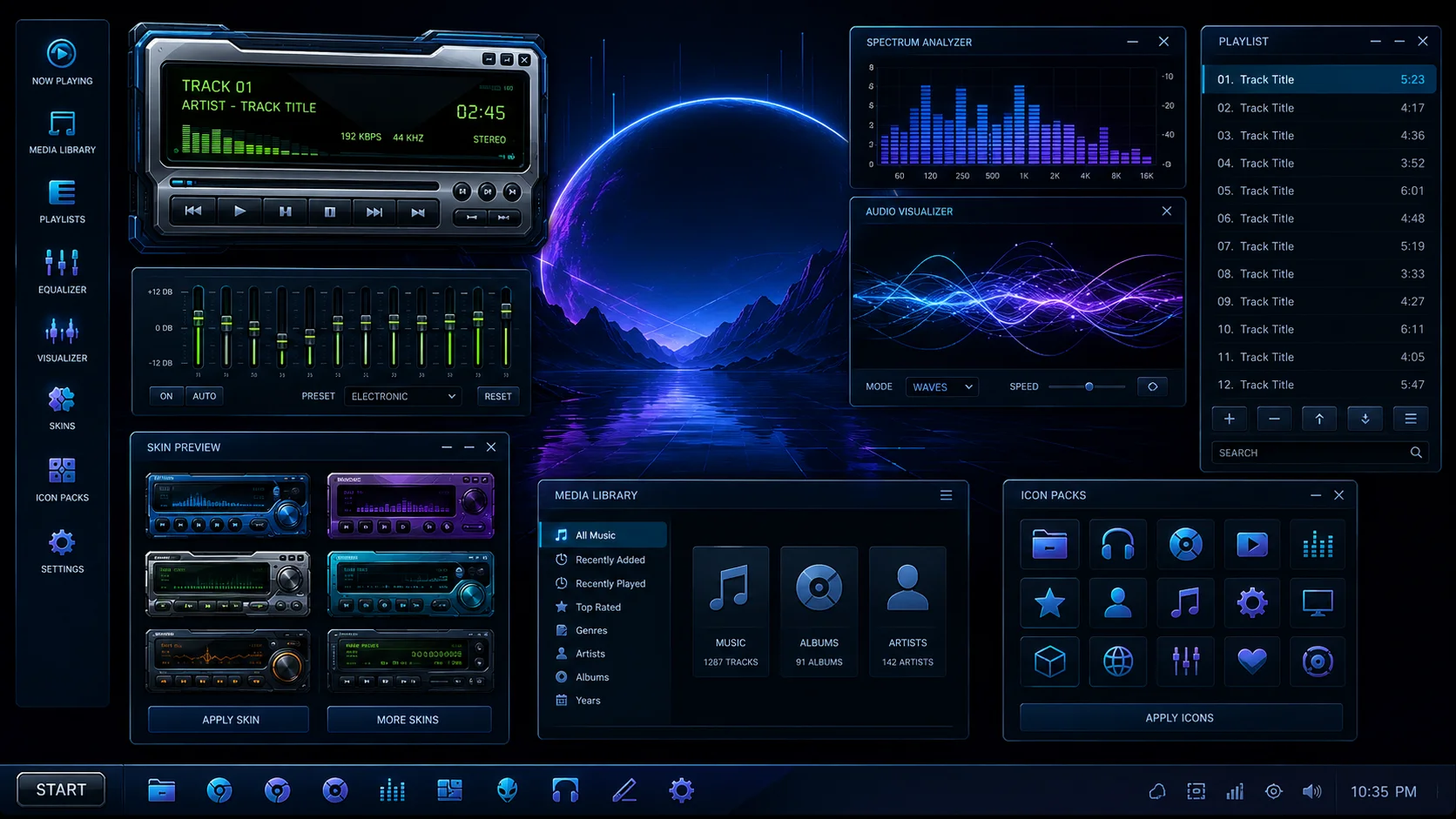
A Winamp window, equalizer, playlist, and visualizer became part of the late 1990s and early 2000s computer experience. Users could play local files, build playlists, install plug-ins, watch visualizers, and change skins to match the rest of their desktop.
For Skinbase, this is where MP3 becomes especially important. The file format created demand for a new kind of music software. That software became a canvas for skinning culture. Winamp, Sonique, and other players were not only tools for playback — they were part of the visual identity of the desktop.
MP3 helped make skinnable software mainstream.
Sonique, MusicMatch, and the Player Wars
Winamp was the icon, but it was not alone.
The MP3 boom created a crowded world of media players. Sonique tried to outstyle Winamp with a futuristic interface, advanced visual identity, and flexible skins. MusicMatch Jukebox focused on library management and ripping. RealPlayer and Windows Media Player competed for broader media playback. JetAudio, Foobar2000, MediaMonkey, and many others found audiences among different types of users.
Each player represented a different idea of what digital music should be. Should the player be small and fast? Should it manage the whole library? Should it look beautiful? Should it support every format? Should it focus on audio quality? Should it connect to online services? Should it be skinnable?
For a while, the answer depended on the user.
Power users experimented. Skinners followed the most visually interesting players. Casual listeners used whatever worked. Collectors built libraries. Audiophiles debated quality. Students traded files across networks. Designers made skins and screenshots.
The MP3 player wars were not just software competition. They were a cultural moment.
Napster: The Shockwave
No history of MP3 can ignore Napster.
Launched in 1999, Napster made it easy for users to find and share MP3 files with each other. It did not create the MP3 format, and it was not the first way people shared music online, but it made the behavior visible at a massive scale.
Napster changed the emotional relationship between listeners and music.
Suddenly, a user could search for almost any song and find someone who had it. Rare tracks, live recordings, old favorites, new singles, mislabeled files, radio edits, remixes, and entire albums became searchable.
For listeners, it felt like magic. For the music industry, it felt like a crisis.
Napster showed that the internet had broken the old distribution model. Music could move globally without discs, stores, warehouses, radio promotion, or official permission. The MP3 file was small enough to travel, and peer-to-peer software made the network feel endless.
The legal battles that followed were massive. Napster was eventually shut down in its original form, but the idea could not be erased. Once people understood that music could be searched, downloaded, stored, and played instantly, the future had changed.
File Sharing After Napster
After Napster, file sharing did not disappear. It fragmented.
Other networks and tools followed. Gnutella, Kazaa, LimeWire, eDonkey, Direct Connect, BitTorrent, private FTP servers, IRC channels, forums, and countless smaller systems kept music moving.
Some of it was illegal. Some of it was gray-area sharing. Some of it involved independent artists, demos, live sets, public-domain audio, or personal archives. But the cultural effect was clear: users expected music to be accessible.
The MP3 file became the basic unit of that expectation. A song was no longer something you had to find in a shop. It was something that might already be somewhere online.
This created both discovery and chaos. People found artists they would never have heard on local radio. They explored genres from around the world. They collected rare tracks and live performances. But artists and labels also lost control of distribution, release timing, and revenue.
MP3 gave listeners power. The industry spent years trying to take that power back or redirect it into legal systems.
Portable Players: Music Leaves the Desk
At first, MP3 was mostly a computer experience. You listened at a desk.
Then portable MP3 players changed the shape of listening.
Early devices had small storage, limited displays, and clunky transfer software, but they pointed toward the future. A user could carry digital files without carrying discs. No skipping CD player. No binder full of albums. No cassette rewinding.
Even a small flash-based MP3 player felt futuristic.
The Diamond Rio became one of the best-known early portable MP3 players. It was small, controversial, and symbolic. It showed that MP3 was not only for computers. It could become a mobile music format.
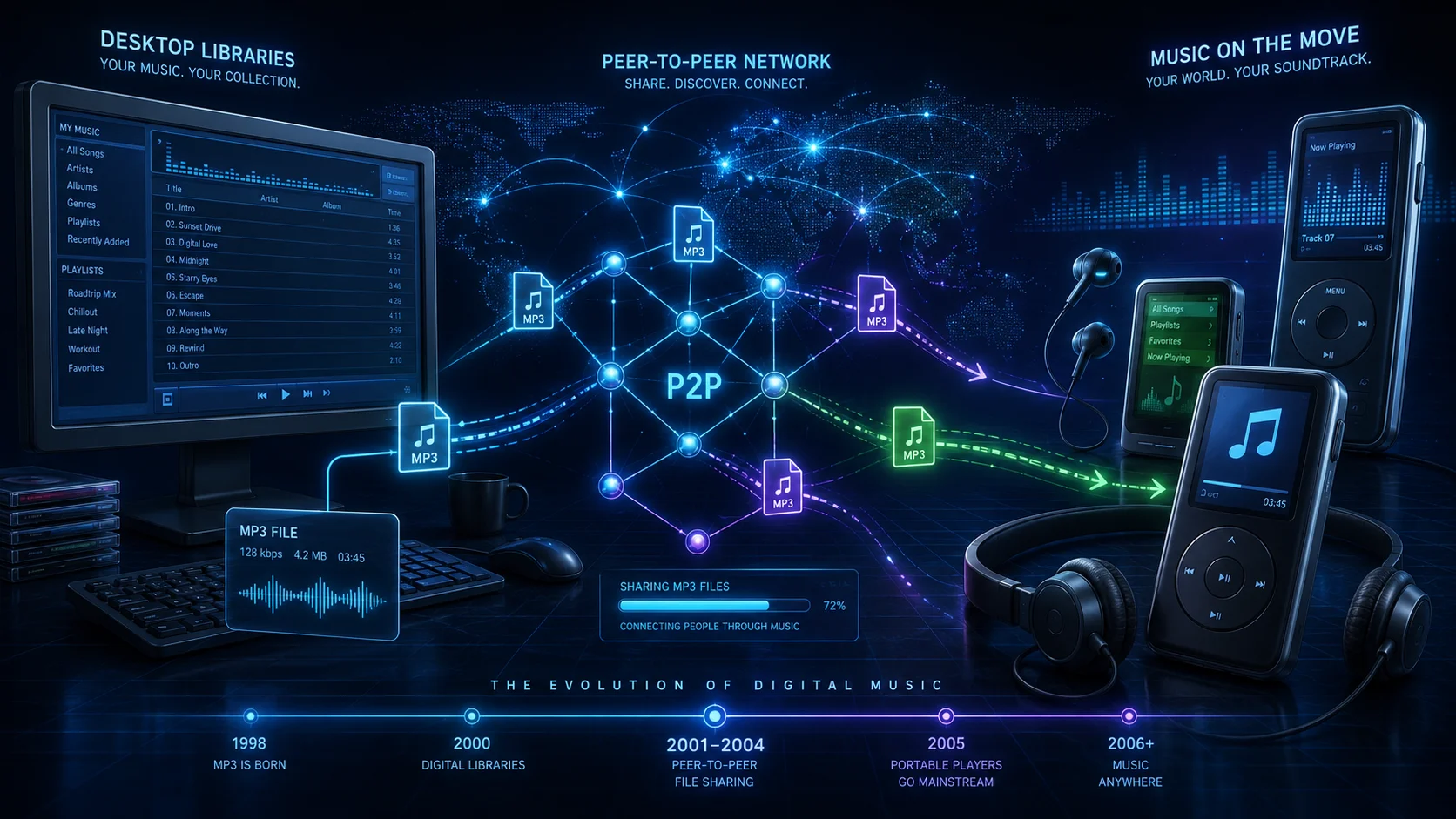
Then Apple introduced the iPod in 2001, and the idea reached a new level. The iPod combined storage, design, simple navigation, and synchronization with iTunes. It made the digital music library portable in a way that felt polished and mainstream.
The desktop library could now travel.
iTunes and the Legal Download Era
Napster proved demand. The iPod proved portability. The missing piece was a legal store that made buying digital music simple.
Apple’s iTunes Music Store arrived in 2003 and helped define the next phase. Users could legally buy individual songs instead of full albums, download them quickly, and sync them to an iPod.
This was a huge shift. The album was no longer the only default unit of purchase. The track became central. A listener could buy one song, build a playlist, and carry it anywhere.
This was not only a technology change. It changed music economics, marketing, and listening habits. Singles became more important. Playlists became personal collections. The digital library became a managed object.
The MP3 format was part of this broader transformation, even when stores used other formats. The cultural behavior had already been established by MP3: music as files, files as collections, collections as personal identity.
Bitrates, Quality, and the Sound Debate
MP3 was never only a convenience story. It was also a quality debate.
Some listeners were satisfied with 128 kbps files because they were small and sounded acceptable on typical computer speakers or cheap headphones. Others wanted 192 kbps, 256 kbps, 320 kbps, or variable bitrate encodes. Audiophiles preferred lossless formats like FLAC or WAV, arguing that MP3 threw away too much information.
These debates were part of the culture.
A user’s bitrate said something about their priorities. Low bitrate meant smaller files and easier sharing. High bitrate meant better quality and larger storage. Variable bitrate promised a smarter balance. Lossless meant archiving without compromise.
In the early years, storage space and bandwidth mattered a lot. A smaller file was practical. Later, as storage became cheap and internet connections improved, higher-quality files became easier to keep.
Even so, MP3 survived because it was good enough. That phrase sounds like an insult, but in technology it is powerful. Good enough, small enough, compatible enough, and easy enough can change the world.
The Local Library as Personal Identity
The MP3 era created a new kind of personal archive.
A music library was no longer just a shelf of albums. It was a folder tree, a media player database, a playlist collection, a tagging project, and sometimes a chaotic memory map of years spent downloading, ripping, sorting, and discovering.
Local libraries had personality.
Some users organized by genre. Some by year. Some by mood. Some had folders named New, Old, Favorites, To Sort, Downloaded, Burn CD, or Best Songs Ever. Some kept every file. Others curated carefully.
Playlists became emotional objects. There were party playlists, driving playlists, study playlists, breakup playlists, workout playlists, game-night playlists, and late-night coding playlists. A playlist could feel like a mixtape, but it was easier to edit, duplicate, and share.
This is another reason MP3 fits Skinbase. Desktop customization and MP3 library culture came from the same desire: users wanted technology to reflect their identity. The desktop skin, the wallpaper, the Winamp skin, the playlist, the folder names, and the music collection all belonged to the same personal digital environment.
Burning CDs and the Hybrid Era
For a while, digital and physical music lived together.
Users downloaded or ripped MP3s, arranged playlists, and then burned them back onto CD-Rs. A computer became a mixtape machine. Custom CDs were made for cars, friends, parties, and portable players that did not yet support MP3.
Some users burned audio CDs. Others burned MP3 data discs that could hold many more songs if the playback device supported them. CD labels were written with markers. Jewel cases got homemade covers. The digital library returned to physical form.
This hybrid era is easy to forget, but it was important. It shows that technology change is rarely instant. People do not jump from one world to another overnight. They mix old habits with new tools.
MP3 lived through that transition beautifully. It worked on computers, portable players, burned discs, websites, and later phones.
Podcasts, Audiobooks, and More Than Music
MP3 also helped expand spoken-word audio.
Because MP3 files were small and widely supported, they became useful for podcasts, lectures, interviews, radio shows, language lessons, audiobooks, and recorded talks.
This mattered because MP3 was not tied to the music industry alone. It was a general audio format that anyone could use.
A small creator could record audio, encode it, upload it, and distribute it. A listener could download episodes and play them on a computer or portable device. This helped prepare the way for podcast culture.
Again, the pattern was the same: compression made distribution easier, and distribution changed behavior.
The Move Toward Streaming
Eventually, the center of digital music moved again.
The MP3 era was built around ownership, or at least possession. Users had files. They stored them locally. They backed them up. They moved them between devices. They worried about missing tags, duplicate files, and hard drive failures.
Streaming changed the model.
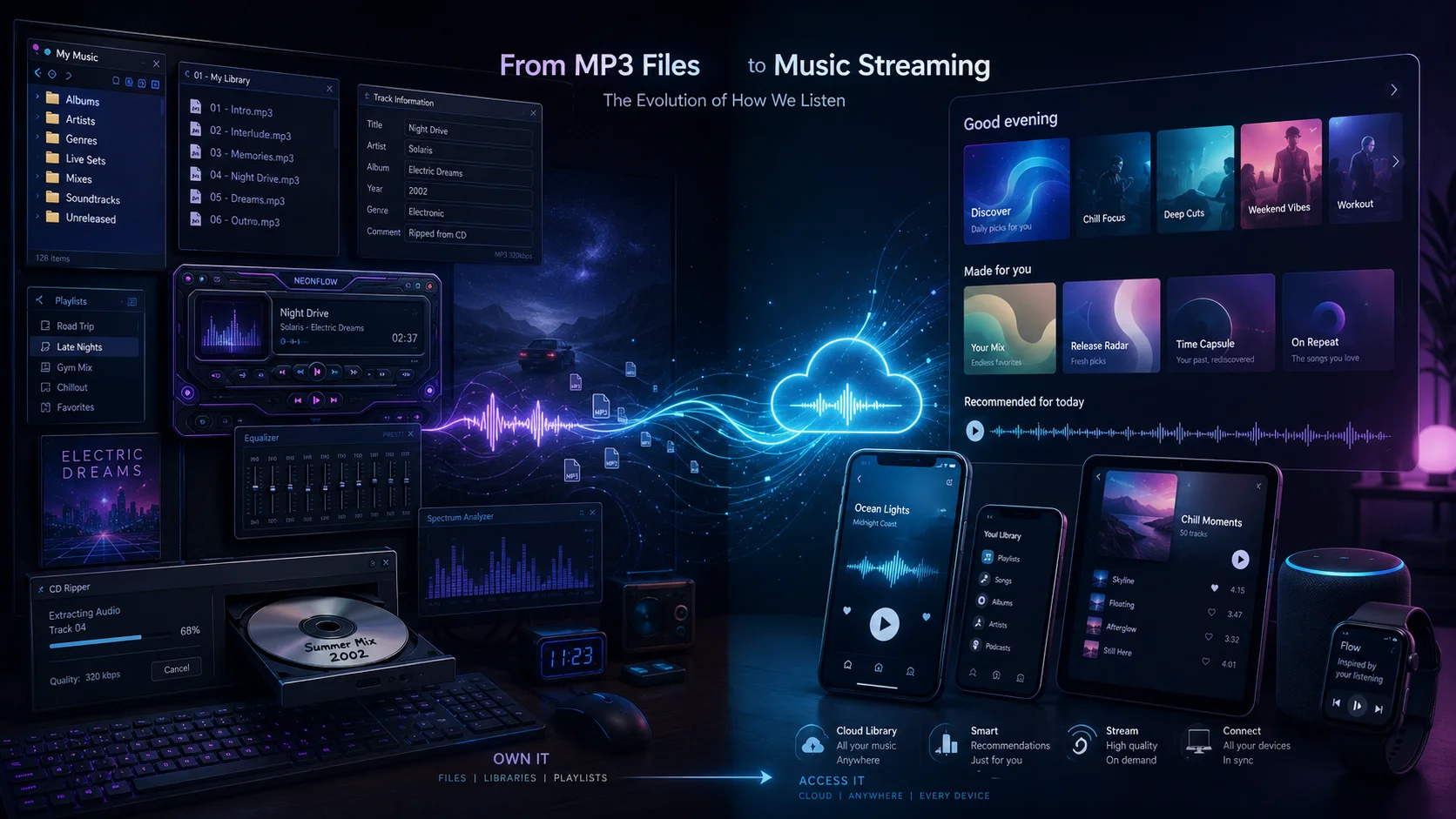
Instead of owning or collecting files, listeners could access a massive catalog on demand. Services like Spotify and others turned music into a cloud-based experience. Search became instant. Playlists became social and algorithmic. Recommendations became automated. Local storage became less important.
This solved many problems. Users no longer had to rip CDs, manage folders, edit tags, or sync libraries manually. New music discovery became easier. Listening could move across devices. A phone could access more music than any old hard drive collection.
But something was lost too.
The local library felt personal in a way that streaming libraries often do not. MP3 collections were messy, handmade, and owned. Streaming is convenient, but it often feels rented, licensed, and platform-controlled.
The MP3 era was about building a collection. The streaming era is about accessing a service. That difference matters.
Did MP3 Die?
In 2017, the MP3 licensing program ended after key patents expired. Some headlines described MP3 as dead, but that was never really true in a cultural sense.
MP3 did not die. It became ordinary.
By then, newer formats such as AAC, Opus, FLAC, and others had become important in different contexts. Streaming services often used more modern codecs. Audiophiles kept lossless archives. Developers had better technical options.
But MP3 remained everywhere.
It was supported by almost every device, player, operating system, browser, editor, car stereo, and media library. It became the common language of digital audio.
That is a different kind of success. The most revolutionary technologies eventually become invisible. People stop being amazed by them because they have become part of the environment.
MP3 reached that point.
Why MP3 Still Matters
MP3 matters because it changed the assumptions around music.
Before MP3, music distribution was controlled mostly by physical media, broadcasters, stores, labels, and manufacturers. After MP3, music could be copied, compressed, moved, searched, played, and shared by ordinary users on ordinary computers.
It created new freedoms and new conflicts. It helped listeners discover more music. It helped independent artists distribute audio more easily. It challenged record labels. It made piracy mainstream. It forced legal digital stores to evolve. It helped portable players become popular. It prepared listeners for streaming.
Most importantly, it changed the listener’s mindset.
Music became something you could manage. You could rename it. Tag it. Sort it. Skin the player. Build the playlist. Burn the disc. Copy the folder. Carry the device. Share the file. Archive the collection.
That kind of control shaped an entire generation of computer users.
MP3 and Skinbase
For Skinbase, MP3 is not just an audio format. It is part of the same digital culture as desktop skinning.
MP3 created the need for music players. Music players created demand for skins. Skins created communities. Communities created galleries, screenshots, comments, ratings, downloads, and visual identity.
Winamp skins, Sonique skins, visualizers, playlist windows, custom equalizers, desktop widgets, and music-themed wallpapers all grew from the same moment.
The MP3 file sat quietly underneath it all. It was the reason the player was open. It was the reason the playlist mattered. It was the reason users spent hours organizing music while changing the look of their desktop.
A customized desktop in the early 2000s often had three important parts: a wallpaper, a messenger, and a music player. MP3 powered one of them.
That makes it part of Skinbase history.
Timeline: MP3 and the Digital Music Shift
Late 1980s–Early 1990s: Researchers develop audio compression techniques that will become part of the MPEG audio standards.
1995: The .mp3 file extension is chosen, giving MPEG Audio Layer III the short, memorable name that becomes famous worldwide.
1996: ID3 tagging emerges as a way to store basic metadata inside MP3 files, helping songs carry artist, title, album, year, and genre information.
1997: Winamp becomes one of the most iconic MP3 players and helps connect MP3 playback with desktop skinning culture.
1998: Portable MP3 players begin to reach consumers, proving that digital music can leave the desktop and fit in a pocket.
1999: Napster launches and brings MP3 file sharing into mainstream conversation, triggering one of the biggest music industry battles of the internet age.
2001: The iPod is introduced, helping turn the digital music library into a mainstream portable experience.
2003: The iTunes Music Store helps define the legal download era and makes individual digital song purchases easier for mainstream users.
Mid-2000s: MP3 libraries, portable players, CD ripping, file sharing, and digital downloads become normal parts of everyday music culture.
Late 2000s–2010s: Streaming services begin to shift music from file ownership to cloud access.
2017: The MP3 licensing program ends after key patents expire, marking the end of one official chapter but not the end of MP3’s cultural life.
2020s: MP3 is no longer the cutting edge of audio technology, but it remains one of the most recognized and widely compatible digital audio formats ever created.
The Legacy of MP3
MP3 changed music because it changed what a song could be.
A song could be a file.
That sounds simple now, but it was revolutionary.
Once music became a file, everything else followed: ripping, tagging, downloading, sharing, playlisting, portable players, online stores, podcasts, streaming, and the expectation that music should be instantly accessible.
MP3 was not perfect. It compressed sound. It caused legal chaos. It encouraged piracy. It disrupted artists, labels, shops, radio, and listeners all at once.
But it also opened doors.
It made music feel closer to the user. It turned computers into jukeboxes. It gave independent creators new paths. It made playlists personal. It helped build the culture around Winamp, Sonique, visualizers, skins, and desktop music setups.
MP3 was the sound of the internet becoming personal.
And for anyone who remembers organizing folders, editing tags, downloading tracks overnight, choosing the perfect Winamp skin, and watching a visualizer glow in the dark, MP3 was more than a format.
It was a feeling. It was the moment music became part of the desktop.
Connected in Nova
6 linkediis.fraunhofer.de
Reference link
https://www.iis.fraunhofer.de/en/magazin/panorama/2025/30-years-of-mp3.html
iis.fraunhofer.de
Reference link
https://www.iis.fraunhofer.de/en/ff/amm/prod/audiocodec/audiocodecs/mp3.html
id3.org
Reference link
https://id3.org/
britannica.com
Reference link
https://www.britannica.com/topic/Napster
apple.com
Reference link
https://www.apple.com/newsroom/2001/10/23Apple-Presents-iPod/
newsroom.spotify.com
Reference link
https://newsroom.spotify.com/company-info/
Related Articles
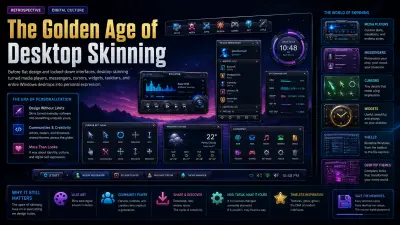
The Golden Age of Desktop Skinning
Before flat design and locked-down interfaces, desktop skinning turned media players, messengers, cursors, widgets, taskbars, and entir...
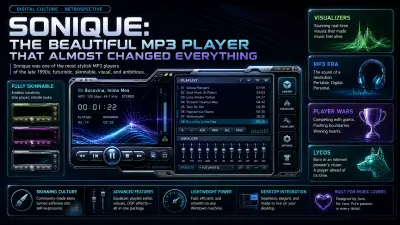
Sonique: The Beautiful MP3 Player That Almost Changed Everything
Sonique was one of the most stylish MP3 players of the late 1990s: futuristic, skinnable, visual, and ambitious. It never defeated Wina...
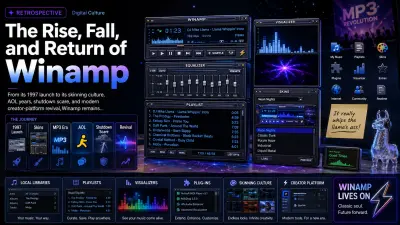
The Rise, Fall, and Return of Winamp
From its 1997 launch to its skinning culture, AOL years, shutdown scare, and modern creator-platform revival, Winamp remains one of des...
Conversation
0 Comments
Keep the discussion focused on the article. Safe markdown formatting is supported for signed-in members.
No comments yet
Start the conversation if you have feedback, context, or a question about this update.