
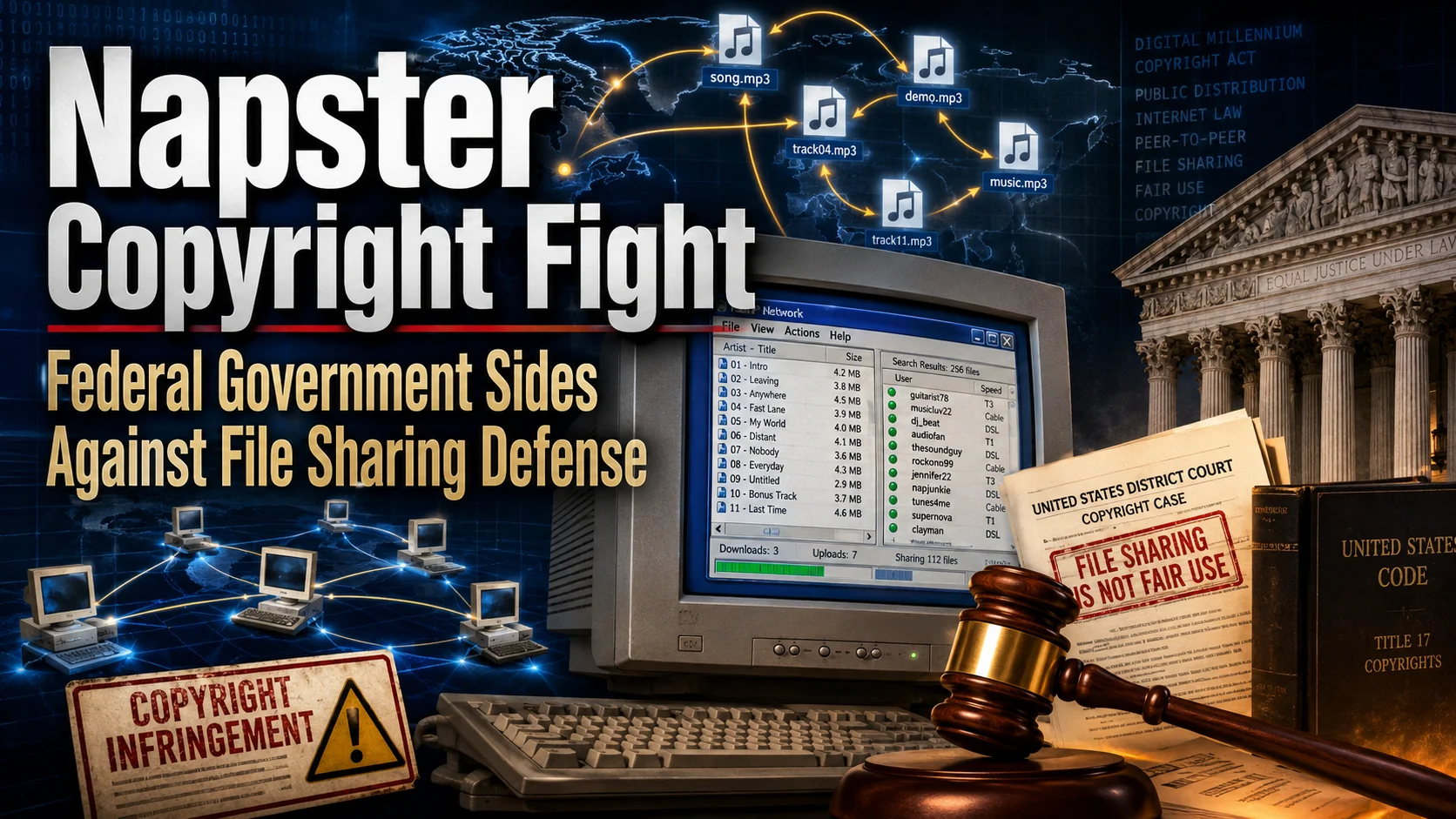
The U.S. Copyright Office has weighed in against Napster, arguing that the music-sharing service cannot use the Audio Home Recording Act as protection against claims that it enables widespread copyright infringement.
The federal government has stepped into the closely watched legal battle against Napster Inc., saying the music-sharing service is not protected by a key copyright law the company has cited in its defense.
In briefs filed with the 9th U.S. Circuit Court of Appeals, lawyers for the U.S. Copyright Office argued that Napster could not rely on the Audio Home Recording Act to defend itself against claims that it helped users share copyrighted music on a massive scale.
The government’s position is not binding on the court, but it supports the earlier ruling by U.S. District Judge Marilyn Hall Patel, who found that Napster was contributing to widespread copyright infringement.
Napster had argued that the 1992 law, which protects some personal copying of music, should shield its users and therefore protect the company from contributory or vicarious infringement claims. Government lawyers rejected that view, saying the law was created for private home recording, not for public distribution through an online file-sharing service.
The company’s attorney, Robert Silver, said Napster still had other legal defenses and that the government’s filing only challenged one part of Napster’s case. According to Silver, the government did not take issue with Napster’s other arguments.
The case is being watched closely because it has become one of the most important early legal battles of the digital music era. Napster allows millions of users to swap music files online, creating a new culture of peer-to-peer sharing while alarming record labels, artists, publishers, and copyright owners.
The Recording Industry Association of America sued Napster in December 1999, arguing that the service enables large-scale copyright infringement. Judge Patel later granted an injunction against Napster, but the appeals court temporarily stayed that order while the case continued.
At the center of the debate is a question that could shape the future of online media: when does a technology company become responsible for what users share through its platform?
The government’s filing says the Audio Home Recording Act protects consumers who copy music for personal use, but does not provide a defense for public distribution of copied works. That distinction matters because Napster users were not only making private copies; they were making files available to millions of other users.
RIAA general counsel Cary Sherman said the government’s brief shows that Napster’s argument is flawed. According to the recording industry, Napster cannot claim immunity under a law that was not designed to protect public online distribution.
Napster maintains that neither its users nor the company are violating copyright law. The company has asked the court to reverse and vacate the injunction, arguing that if users are not infringing, Napster should not be liable for contributory infringement.
For technology fans, musicians, and internet users, the case is much bigger than one company. It touches on file sharing, digital distribution, copyright law, personal copying, online platforms, and the future of music on the internet.
Whatever the court decides, the Napster case has already changed the conversation. Music is no longer tied only to CDs, stores, and traditional distribution. The internet has opened a new world of sharing, and the law is now being forced to decide where innovation ends and infringement begins.
Sources: U.S. Copyright Office amicus brief and Wired report.
Related Articles
Google Pushes AI Creativity Further at I/O 2026
Google I/O 2026 introduced a new wave of AI updates for creators, including tools for image editing, video generation, search, agents,...
Apple WWDC 2026 Begins June 8 with AI and Developer Tool Updates
Apple’s WWDC 2026 starts on June 8 with platform updates, AI advancements, developer tools, and sessions for the Apple ecosystem.

Windows 11 May Get a Noticeable Performance Boost for App Launches
Microsoft is reportedly testing a Windows 11 performance feature that briefly boosts CPU frequency during high-priority actions to make...
Avatar: Frontiers of Pandora Art Blast Shows Cinematic Environment Design
ArtStation’s Avatar: Frontiers of Pandora – From the Ashes Art Blast highlights Ubisoft’s cinematic environment design, darker worldbui...
Conversation
0 Comments
Keep the discussion focused on the article. Safe markdown formatting is supported for signed-in members.
No comments yet
Start the conversation if you have feedback, context, or a question about this update.