
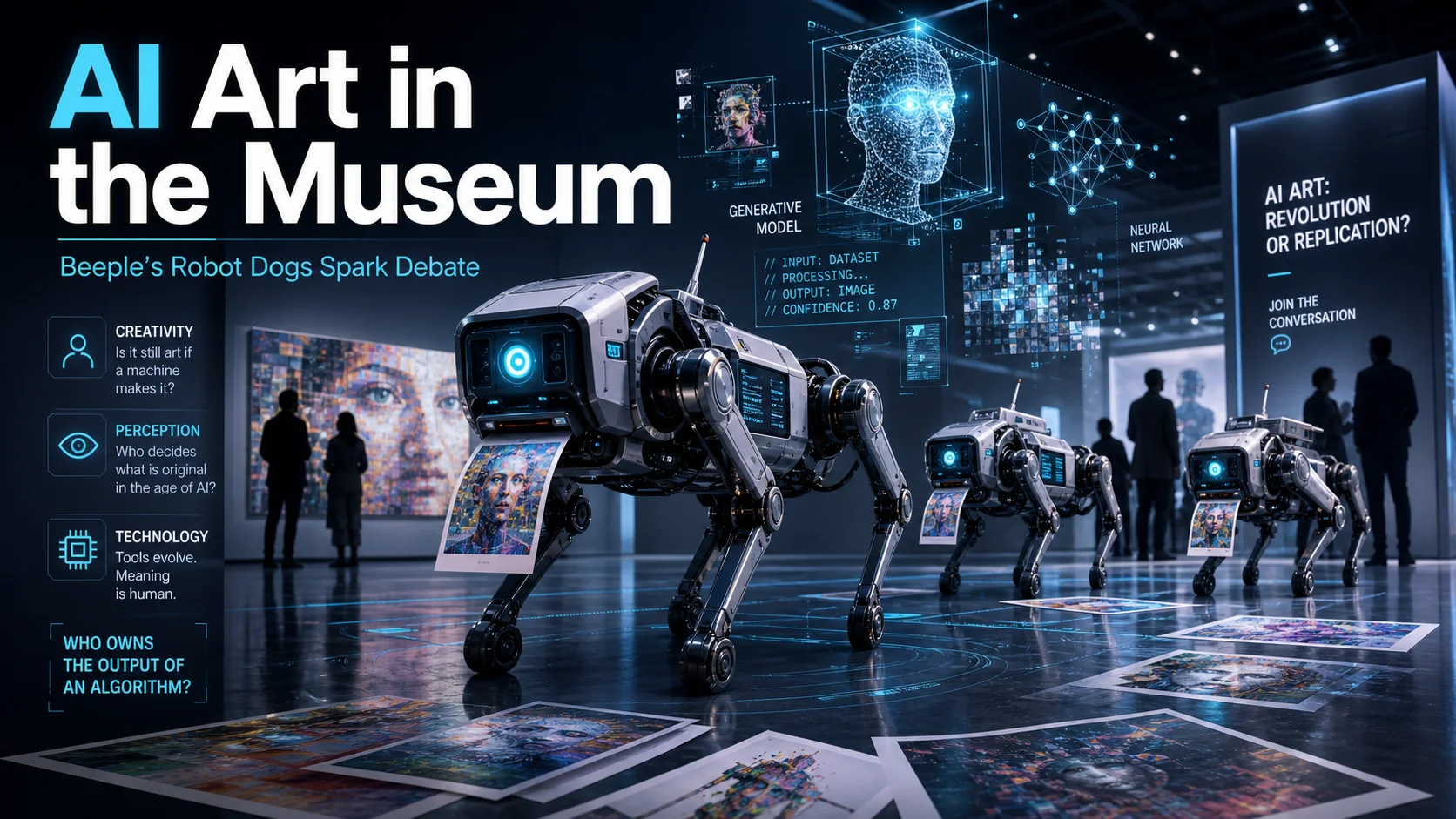
Beeple’s Regular Animals installation at Berlin’s Neue Nationalgalerie uses robotic dogs, AI-transformed images, and digital culture references to question how algorithms and technology platforms shape modern perception.
Beeple has brought a strange, provocative, and very modern digital art debate into Berlin’s Neue Nationalgalerie.
The American digital artist, whose real name is Mike Winkelmann, is presenting Regular Animals, an interactive installation that combines robotics, artificial intelligence, digital culture, and social commentary. The exhibition is being shown at the Neue Nationalgalerie from 29 April to 10 May 2026 and marks Beeple’s first presentation in Germany.
At the center of the installation are autonomous robotic dogs fitted with hyper-realistic silicone heads modeled after globally recognizable figures, including Elon Musk, Mark Zuckerberg, Jeff Bezos, Andy Warhol, Pablo Picasso, and Beeple himself. The robots move inside a pen-like environment, capturing images of their surroundings through onboard cameras.
Those captured images are then transformed by artificial intelligence to reflect the personality, style, or worldview associated with each figure. The Picasso dog may generate a Cubist-style image, while the Warhol dog produces something closer to pop art. The result is deliberately absurd, but also a sharp commentary on how reality can be filtered, interpreted, and reshaped by systems we do not fully see.
The idea behind Regular Animals is not only to make visitors smile or feel uncomfortable. It asks a serious question: who shapes the way we see the world today?
In earlier eras, artists, writers, photographers, filmmakers, and cultural movements helped define how society interpreted reality. Today, Beeple suggests, perception is increasingly shaped by algorithms, recommendation systems, social media platforms, and the powerful people who control them. A small change inside a platform can influence what millions of people see, ignore, believe, or discuss.
That makes the installation especially relevant for digital artists and online creative communities. Many artists now create inside an ecosystem controlled by platforms, feeds, ranking systems, AI models, and engagement metrics. Visibility is no longer only about talent or originality. It is also about how machines classify, recommend, and distribute creative work.
The Neue Nationalgalerie describes the work as a physical-digital environment that expands Beeple’s engagement with artificial intelligence and digital art into an immersive museum installation. This makes Regular Animals more than a robotics spectacle; it becomes a museum-scale reflection on the systems behind digital culture.
For Beeple, this is another step in a career built around digital art, internet culture, satire, and the changing value of images. His digital collage Everydays: The First 5000 Days became one of the most famous NFT-related artworks after selling at Christie’s for more than $69 million in 2021.
What makes Regular Animals interesting for the Skinbase community is how many questions it touches at once. Is AI a creative tool, a filter, a mirror, or a machine for manipulating perception? Who owns the image after it has been captured, transformed, printed, and possibly tokenized? And when an artwork is generated through cameras, robots, algorithms, and cultural references, where does authorship begin and end?
These are no longer abstract questions. They affect illustrators, wallpaper creators, digital painters, photographers, 3D artists, theme designers, and anyone publishing visual work online.
Beeple’s robot dogs may look bizarre at first glance, but that is part of the point. The installation turns the invisible machinery of digital culture into something physical, awkward, funny, and unsettling. It gives algorithms a body, gives platforms a face, and asks visitors to think about how much of their worldview is being shaped before they even realize it.
For digital art, this is exactly the kind of conversation that matters now.
Sources: Neue Nationalgalerie exhibition page and Associated Press report.
Related Articles
Google Pushes AI Creativity Further at I/O 2026
Google I/O 2026 introduced a new wave of AI updates for creators, including tools for image editing, video generation, search, agents,...
Apple WWDC 2026 Begins June 8 with AI and Developer Tool Updates
Apple’s WWDC 2026 starts on June 8 with platform updates, AI advancements, developer tools, and sessions for the Apple ecosystem.

Windows 11 May Get a Noticeable Performance Boost for App Launches
Microsoft is reportedly testing a Windows 11 performance feature that briefly boosts CPU frequency during high-priority actions to make...
Avatar: Frontiers of Pandora Art Blast Shows Cinematic Environment Design
ArtStation’s Avatar: Frontiers of Pandora – From the Ashes Art Blast highlights Ubisoft’s cinematic environment design, darker worldbui...
Conversation
0 Comments
Keep the discussion focused on the article. Safe markdown formatting is supported for signed-in members.
No comments yet
Start the conversation if you have feedback, context, or a question about this update.